
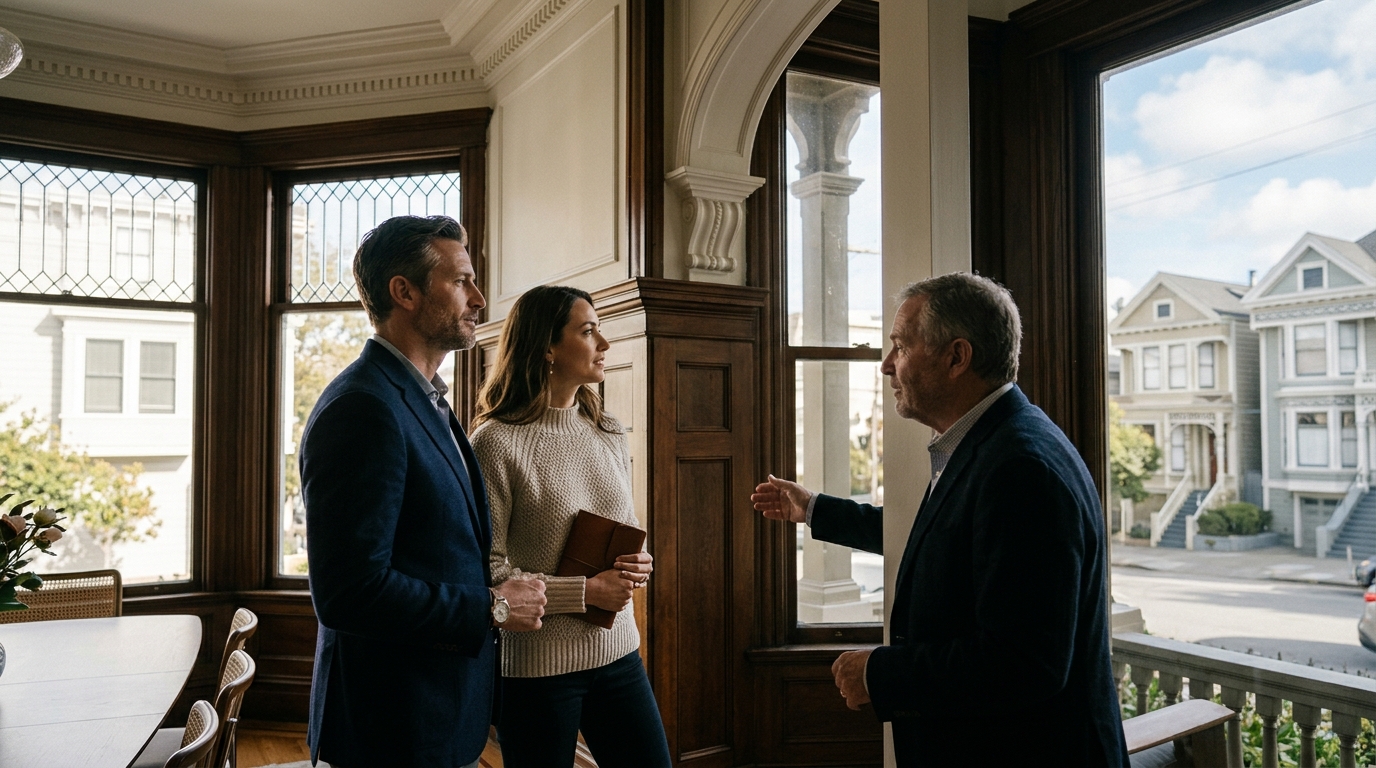
Questions to Ask a Luxury Real Estate Agent Before Buying a Historic Property in the San Francisco Bay Area
San Francisco's historic homes are among the most architecturally significant in the United States, spanning Victorian, Edwardian, and Craftsman styles dating back to the mid-1800s. But buying one is far more complex than purchasing a modern build. From seismic retrofitting and preservation regulations to the Mills Act tax benefits, the right questions can save you hundreds of thousands of dollars and years of frustration. Below are the essential questions every buyer should ask a luxury real estate agent before signing on the dotted line for a historic Bay Area property.
1. What Architectural Style Is This Property and Why Does It Matter?
A Victorian home is a property built during the reign of Queen Victoria (roughly 1837 to 1901), characterized by intricate woodwork, steep gable roofs, and elaborate ornamental accents. An Edwardian home is a property from the early 1900s that emphasizes balance and simplicity with fewer decorative elements. A Craftsman bungalow is a home style popular during the early twentieth century, known for handcrafted details, natural materials, and open layouts.
Understanding the exact style affects everything from insurance costs to resale value. Ask your agent to identify whether the home is Queen Anne, Italianate, Stick, or another sub-style, and what that means for maintenance budgets. Explore San Francisco neighborhood guides to see where these styles cluster.
2. What Local Preservation Regulations Apply to This Property?
San Francisco's Planning Department Historic Preservation program enforces strict guidelines through Articles 10 and 11 of the Planning Code. Article 10 establishes the city's official list of landmarks and historic districts, while Article 11 governs conservation districts in the downtown core.
Before making an offer, ask your agent whether the property is individually landmarked, a contributor to a historic district, or located in a conservation district. Each designation carries different rules about what you can and cannot change on the exterior and interior.
3. Has the Property Been Seismically Retrofitted?
Earthquake safety is non-negotiable in the Bay Area. Many pre-1940 homes sit on pier-and-post or cripple wall foundation systems that are vulnerable to seismic activity. Ask your agent about the property's foundation type, whether a seismic retrofit has been completed, and what it would cost if it has not.
A qualified agent will coordinate specialized inspections and connect you with structural engineers who understand historic construction methods. Review past client experiences to see how a detail-oriented agent handles these critical assessments.

4. Does This Property Qualify for the Mills Act?
The Mills Act is a California state law that allows cities to enter into contracts with owners of historic structures, providing a property tax reduction in exchange for ongoing preservation. In San Francisco, this can result in a potential 50 percent reduction in property taxes for qualified properties.
To qualify, a property must be individually listed on the National Register of Historic Places, designated as a City landmark under Article 10, or meet other specific criteria. Applications must be submitted before May 1 each year. Ask your agent whether the property already has a Mills Act contract or is eligible for one.
| Incentive | Potential Savings | Eligibility | Application Deadline |
|---|---|---|---|
| Mills Act (SF) | Up to 50% property tax reduction | Landmark, historic district contributor, or National Register listing | May 1 annually |
| Federal Historic Tax Credit | 20% of qualified rehabilitation costs | Income-producing properties on the National Register | Rolling |
| California State Historic Tax Credit | Varies by project | Qualified historic buildings per SB451 (signed 2019) | Rolling |
5. What Renovation Restrictions Should I Expect?
Historic homes in San Francisco often fall under the jurisdiction of the Landmarks Preservation Advisory Board, which reviews proposed alterations. Ask your agent to explain which changes require formal approval and which do not. In many cases, interior updates are more flexible, but exterior modifications to a landmarked property must align with the Secretary of the Interior's Standards for the Treatment of Historic Properties.
A knowledgeable agent can help you understand the difference between sympathetic updates that complement the home's character and modifications that could trigger costly review processes. Philip Farr's background in analytical problem-solving is especially valuable when navigating these regulatory layers.
6. Can You Access Off-Market Historic Listings?
Many of San Francisco's finest historic properties never appear on the MLS. In neighborhoods like Pacific Heights and Presidio Heights, 20 to 30 percent of luxury transactions involve off-market components. Multi-generational family estates and legacy properties are frequently sold through private broker networks built on years of trust.
Ask your agent about their process for accessing pocket listings and whether they can share examples of off-market transactions they have completed. Read more about how off-market properties work in San Francisco to understand the strategies involved.
7. Which Neighborhoods Reward Historic Preservation Investments?
Not every San Francisco neighborhood offers the same return on preservation investment. Areas like Pacific Heights, Alamo Square, and Presidio Heights tend to reward museum-level restoration with higher resale premiums. Other neighborhoods may not justify the cost of period-accurate materials and craftsmanship.
Ask your agent for a neighborhood-by-neighborhood breakdown of where historic character commands a premium. Use the Philip Farr Properties listings page to compare current inventory across top neighborhoods and evaluate which areas align with your goals.
What to Look for in Neighborhood Data
Request recent comparable sales of restored historic homes versus modernized ones. Your agent should be able to show you the price differential and help you decide whether a full restoration or a sympathetic renovation is the smarter financial play.
Key Takeaways
- Always identify the exact architectural style and sub-style before evaluating a historic property.
- Verify the property's historic designation status under San Francisco Planning Code Articles 10 and 11.
- Prioritize seismic safety by asking about foundation type and retrofit history.
- Explore Mills Act eligibility for up to 50% property tax savings on qualified historic homes.
- Understand renovation restrictions before budgeting for any modifications.
- Work with an agent who has proven off-market access in neighborhoods with high historic property concentrations.
- Choose neighborhoods where preservation investments translate to measurable resale value.
Frequently Asked Questions
What is the Mills Act and how does it save money on a historic home?
The Mills Act is a California state law enacted in 1976 that allows local governments to reduce property taxes for owners of qualified historic properties who commit to preserving and maintaining them. In San Francisco, the savings can reach up to 50 percent of your property tax bill.
How do I know if a San Francisco home qualifies as historic?
A property may qualify if it is individually listed on the National Register of Historic Places, designated as a City landmark under Article 10 of the Planning Code, or rated as significant or contributory under Article 11. Your agent and the SF Planning Department can help verify status.
What is seismic retrofitting and is it required for older homes?
Seismic retrofitting is the process of strengthening an older building's structure to better withstand earthquake forces. While San Francisco has mandatory retrofit requirements for certain building types, not all single-family historic homes are covered. A structural engineer's assessment is essential.
Can I modernize the interior of a historic home in San Francisco?
Generally, interior changes are more flexible than exterior alterations, especially for landmarked properties. However, if the home has specific interior features cited in its landmark designation, those elements may be protected. Always confirm with your agent and the Planning Department before starting work.
What percentage of luxury homes sell off-market in San Francisco?
In premium neighborhoods like Pacific Heights and Presidio Heights, an estimated 20 to 30 percent of luxury transactions involve off-market components. Working with a well-connected buyer's agent significantly increases your access to these private opportunities.
How much does it cost to restore a Victorian home in San Francisco?
Costs vary widely depending on the scope. Period-accurate exterior restoration can run into the hundreds of thousands, while sympathetic interior updates may cost significantly less. Your agent should connect you with contractors experienced in historic preservation to get accurate estimates.
Why should I work with a specialist agent for historic properties?
Historic property transactions involve layers of regulation, specialized inspections, and niche market knowledge that general agents may not possess. A specialist understands preservation economics, landmark commission processes, and which neighborhoods reward authentic restoration.
Ready to Find Your Historic Bay Area Home?
Buying a historic property in San Francisco requires an agent who combines deep local knowledge with analytical precision and genuine passion for architecture. Schedule a free consultation with Philip Farr to start your search with an expert who understands the nuances of the Bay Area's most significant properties.